For this landscape design for the villa, situated in Shaoxing to the south of the Yangtze River, we wanted to honor the town and the associated memories it holds for its inhabitants over the years. People who grew up here always carry the memory of raindrops on the roof. The region is renowned for its significant rainfall, and the town is famous for its canal network, bridges, and picturesque alleys. Designed as an ode to the old Shaoxing, An Villa uses its internal landscape to manifest nostalgia and memories of rain in its architecture.
Before we started considering the landscape concept design, our team sought first to understand the uniqueness of Shaoxing, including the urban and geographical context, as well as its historical background. We developed a deep affection for the village, with its. Idyllic scenes and we appreciated its simplicity and the relationship between the buildings and canals, as well as the link between its people and their landscape. We love the way the villagers integrate traditional design with their environment. Because of the high rain fall, people here tend to live under roofs and eaves. Not only do the roofs protect from the heavy rain, but they allow daily life and activities to continue, including drinking tea communally or enjoying the famous Shaoxing yellow wine.
For the project, we decided to divide the landscape area into two main gardens. The first one sits in front of the villa. The second garden is a sunken space right in the middle of the villa’s architecture. In order to create a garden with a sense of place, we carefully considered the relationship between the architecture and the site, the relationship between the people and the landscape, and the relationship between the architecture and hydrology. These three relationships guided the design of our garden at An Villa.
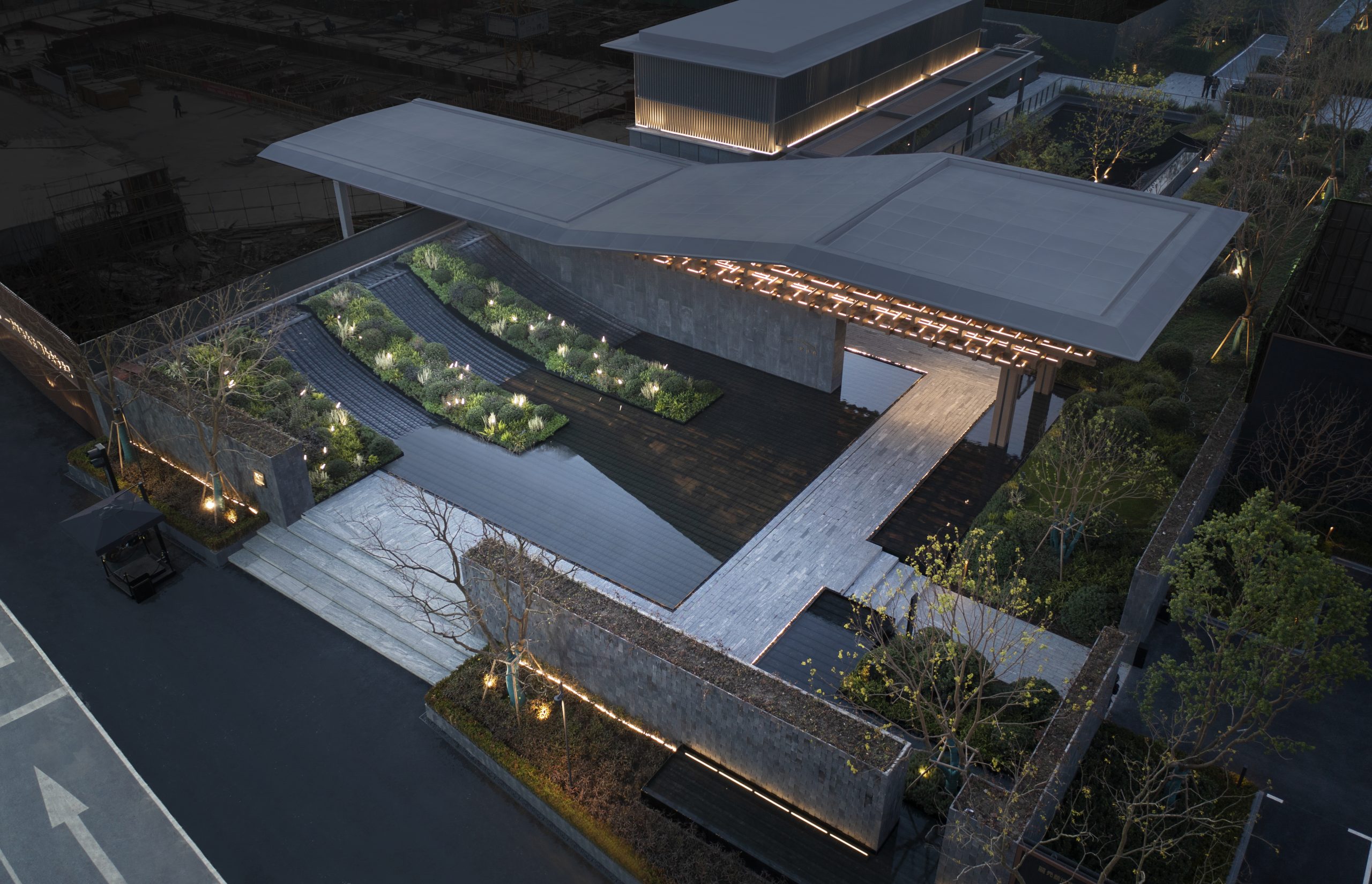
For the first garden, the original context is a flat area right in front of the entry pavilion, which has a prominent roof feature. The left part of the area is a boundary wall. Being a residential project, we posed the question: what sort of garden did we want to create in this space?
Drawing inspiration from typical architectural roofs, we created a roof-like water feature at the arrival court to facilitate the departure and arrival experiences. We selected local roof tiles that had been in use in Shaoxing for centuries to capture the essence of the traditional building methodology, and hired local workers with their knowledge of how to use the material. Thus, local materials, local knowledge, and local techniques were all brought together to create something old and yet new at the same time. For this first entry garden, we selected a mainly ecological and natural planting, combined with exquisite spherical shrubs that impart a sense of sculpture. By creating a rain-like effect, this artistic installation has become the pride and pleasure of Shaoxing architecture and cultural heritage. We constructed an external wall of rough textured dark gray volcano stone wall that beautifully complements the stacking roof design. The overall view of the front garden represents a serene landscape.
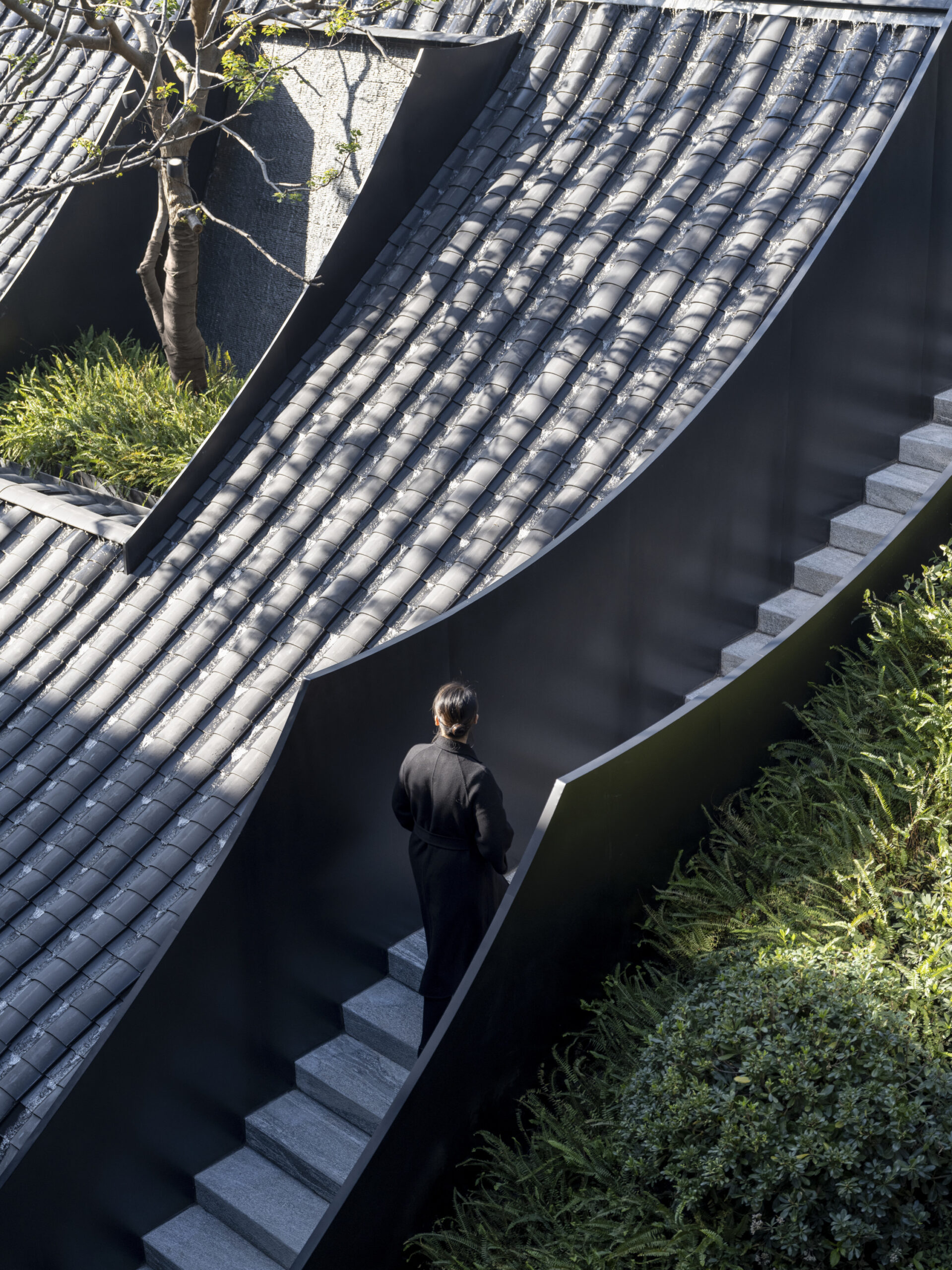
For the second garden, the space was a box-like sunken area with tall retaining walls on three sides of the courtyard. We took into consideration the relationship between the roof and the runoff of water, and looked at how the rainwater in the old town was managed with a system of gutters and eaves. The final design allows for the excess water to pour down the channels of the roof tiles. The sequence of space is rhythmic and we used landscape walls, corridors and plants to open and close the spatial relationships. The team employed a small amount of metal in our design judiciously to increase the artistic contrast of the textures.
We used lush green planting that, when combined with the black tiles and metal, makes the space refreshing and evoking a calming atmosphere. Sitting in the courtyard, one is aware of the different layers of the landscape: the trees, the roof, and the contrasting tiles against the sky. On sunny days, the shadows of the trees cast a natural pattern on the manmade roof. When it rains, the water pours down the slope, while people can sit in the courtyard with a cup of tea, enjoying the sound of the showers. The network we designed drains water efficiently and prevents excess rainwater by allowing it a natural drainage channel. Our team called this second garden the “Roof and Rain Courtyard.”
There’s an old Chinese idiom that states “Flying over the eaves and run on the walls”. It refers to a desire to become a great and powerful personage, powerful enough to climb away from the traditional house structure and over the roof. To this end, we provided a small pathway to one side for the residents to climb. As they ascend, the roof transforms from architecture to a landscape, offering different experiences at the various levels of the new sloping landscape. At the top level, we included a small pathway for both circulation and maintenance purposes.
We designed these two gardens as a respectful nod to the architectural heritage of Shaoxing, and to evoke memories of the old town. The result is something that resembles a traditional roof of memory, yet also something that transforms into a new architectural motif not seen before.
Project name: An Villa
Location: Shaoxing, China
Area: 6,600 m2
Completion: 2021
Photography: DID Studio, YUAN WEI KANG
C O L L A B O R A T I O N
Client: Yoland Real Estate Co.Ltd, Newhope, Vanke Group (Hangzhou)
Architect: Allied Architects International
Interior: Matrix Design
Local Team: Shanghai Weimar Landscape
T R O P S T E R D E S I G N
Director: Pok Kobkongsanti
Team: Jayda Zhu. Yuting Lu, Yiping Liu, Huamei Yin, Pengtao Sang, Ke Ma