Located on the edge of Khao Yai, Thailand’s most important national rainforest reserve, the design of Botanica was directly inspired by the reserve itself, to be seen as a link between nature and contemporary architecture, juxtaposing the crisp clean lines of the structures with the lush greenery of the surrounds.
The site—an abandoned parcel of agricultural land separated into two main plots—faces a local road at the front and is flanked by a small mountain at the rear boundary line. The front plot comprises the project’s residential area, while the rear plot is reserved as a public park for the recreational activities of the residents and visitors.
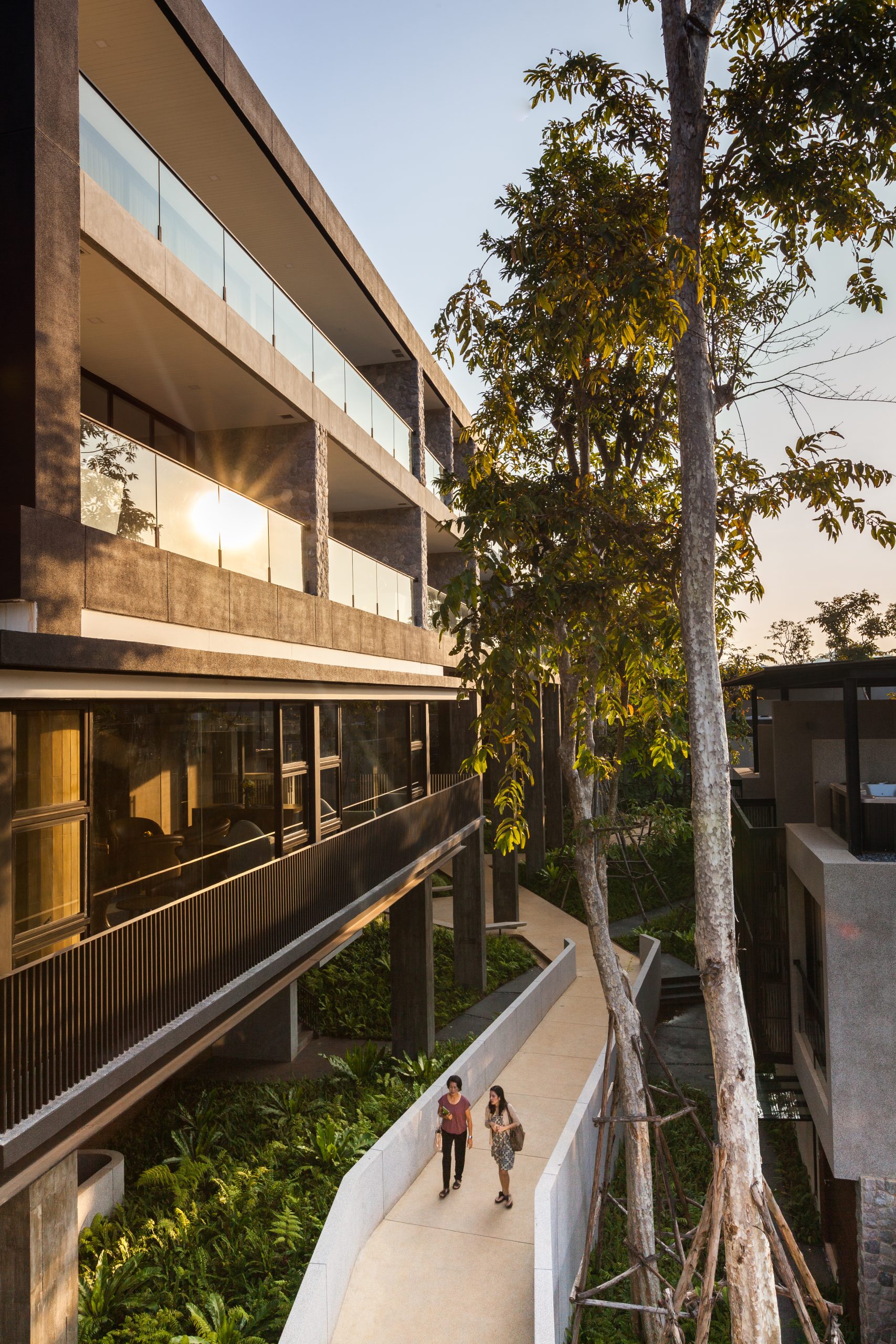
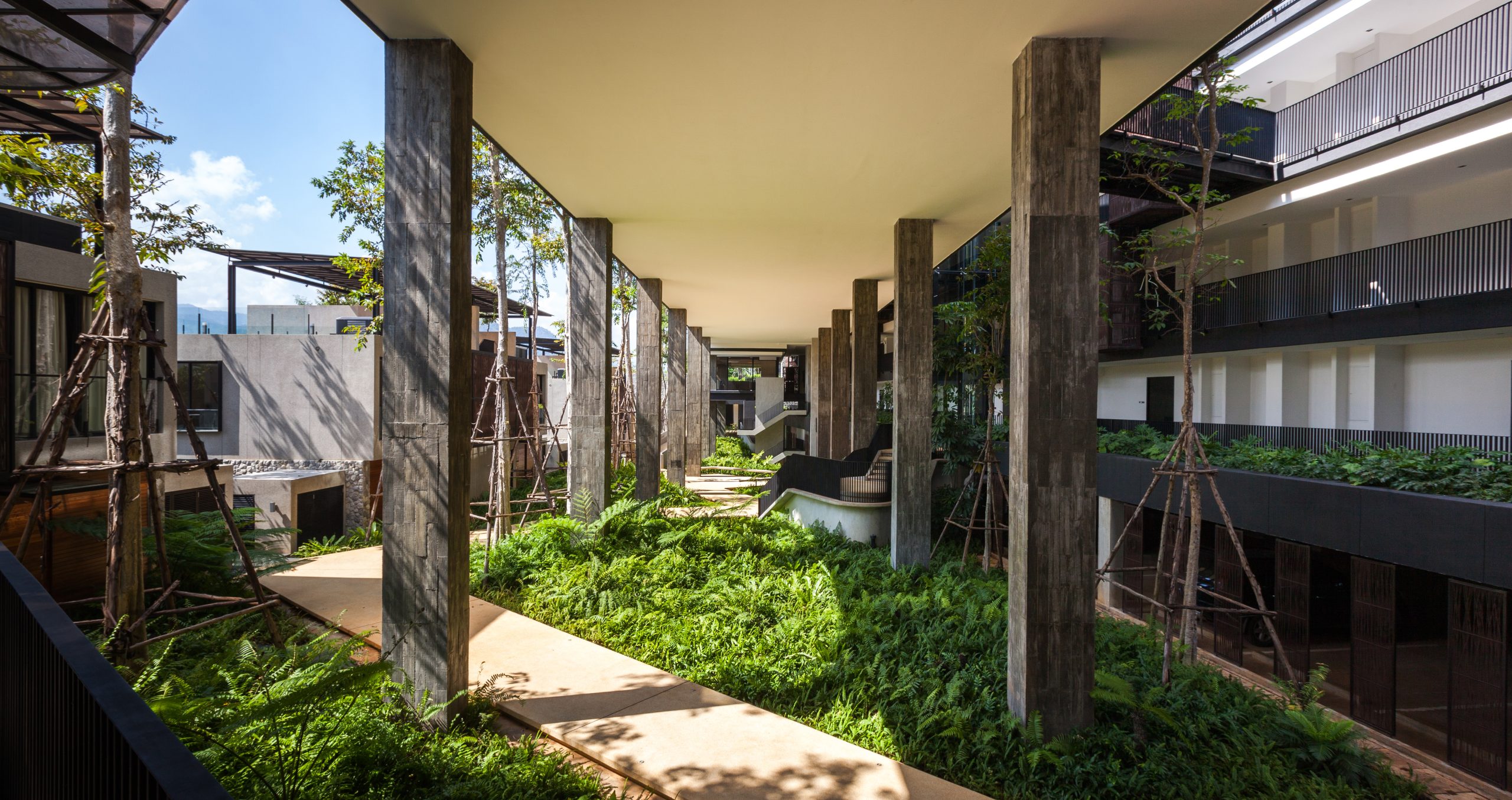
For the residential plot, we needed to fit all unit requirements into a compact area. “The Residences,” a series of residential blocks, are arranged on a landscape platform. Two six-story buildings, called Block A and Block B, are located along the edge between the two land plots. Block B is a simple six-story residential block, while Block A is a bit more complicated: It has a V-shaped layout. One part of the block has units on all six floors, facing the mountain behind. The other part is in the middle of the first plot, elevated four floors from the ground with units only on the top two floors, facing the front of the property. The elevated units are built on gigantic concrete columns, leaving space underneath as a big opening void. Along the roadside there are twelve two-story villas with private gardens and pools.
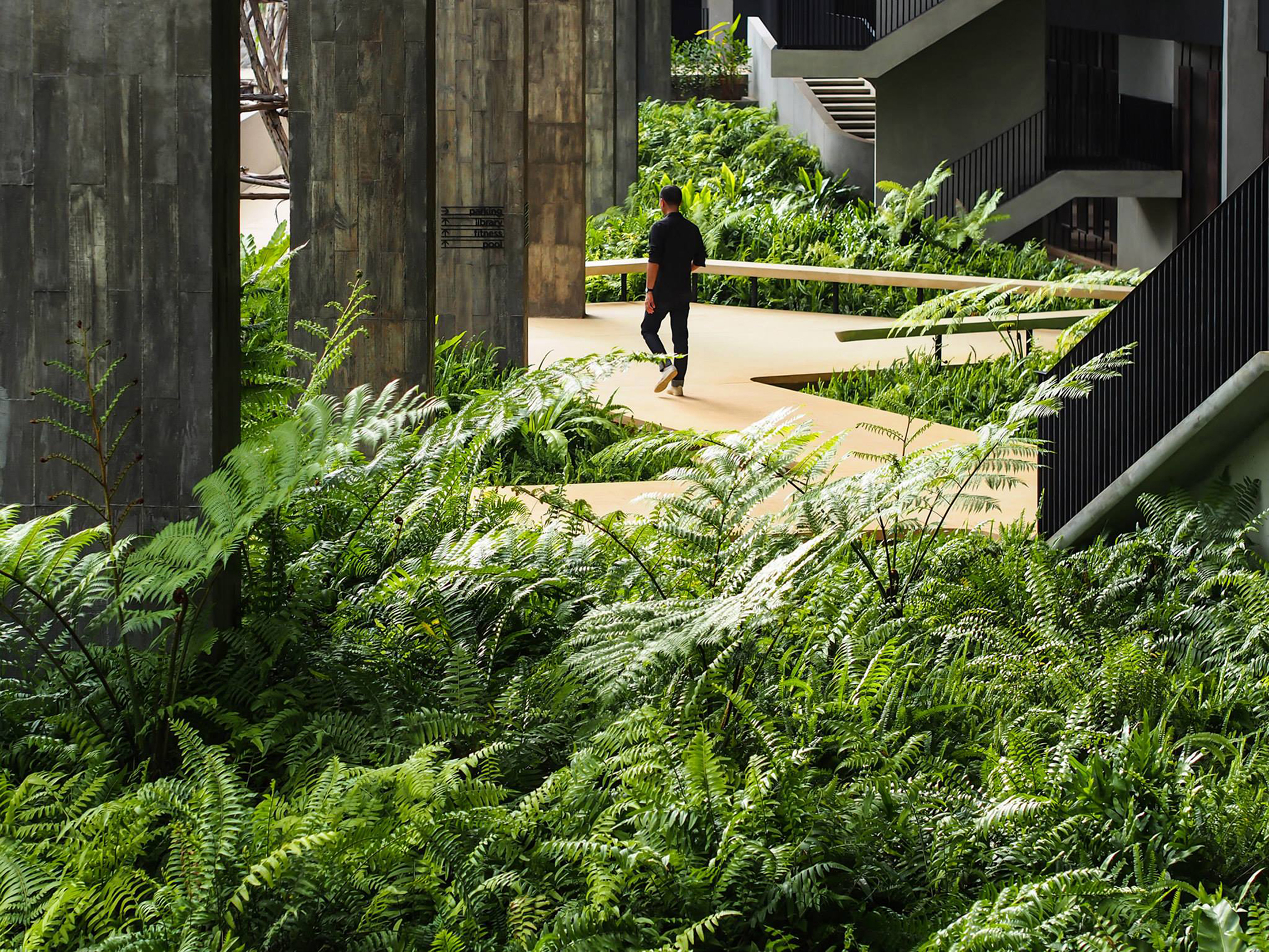
Despite the architecture’s modern and geometrical design, we projected a similar atmosphere to that found in Khao Yai. We utilized the various building heights to maximize on the sunlight qualities throughout the project, using these as the main criteria to re-create a forest-like landscape here. The floating units on the tall columns are reminiscent of the gigantic trees in the forest nearby. Each column is about the same size as the trunks of those trees, and the units above represent the forest canopies. The areas underneath echo the conditions under the natural tree canopies. But nature continues to thrive, often despite the lack of sunlight. Imitating this natural condition, topographic green landforms were created in the shaded residential areas. Local ferns, found in the forest, were used to cover the landform, which we called the Fern Hills. Working with the different qualities of sunlight, the landscape solution successfully introduces an artificial “sustainable forest” to help the residents and visitors feel they are immersed in nature.
The main pedestrian circulation of the area is called “The Path.” This serpentine path meanders over the Fern Hills, left and right, and up and down across the landscape, enabling residents to choose their own route amid the natural surroundings to their accommodations. More than being just a movement artery, the path is also a recreational area, where residents can exercise or take a leisurely walk and experience direct contact with nature. The path is linked to the public areas such as the lobby, clubhouse, lift hall, and corridors, which are all designed as open-air without the use of air-conditioning; instead, creating a cool and shady environment with large trees.
We integrated natural lighting into the entire project, and we selected local materials to harmonize the architecture and the landscape, for example by using locally acquired mountain stone found at the site during the basement’s construction.
For the site’s second (rear) plot, “The Park” was created as the key recreational attraction for all residents and visitors. With the neighboring mountain set against the boundary line, we carefully prepared three layers of subsurface drainage systems to prevent flooding and protect against landslides. Excessive rainwater is harvested and collected for irrigation during the dry season.
A variety of landscape programs were introduced to the property. The Dining Pavilion, hidden by a bamboo forest, is designed to frame the boundary of the park. At the base of the mountain, a green hill is integrated into a reflecting pond, demonstrating the contrast between the artificial and natural landscapes—yet, with the reflection of the mountain, it unites both together seamlessly.
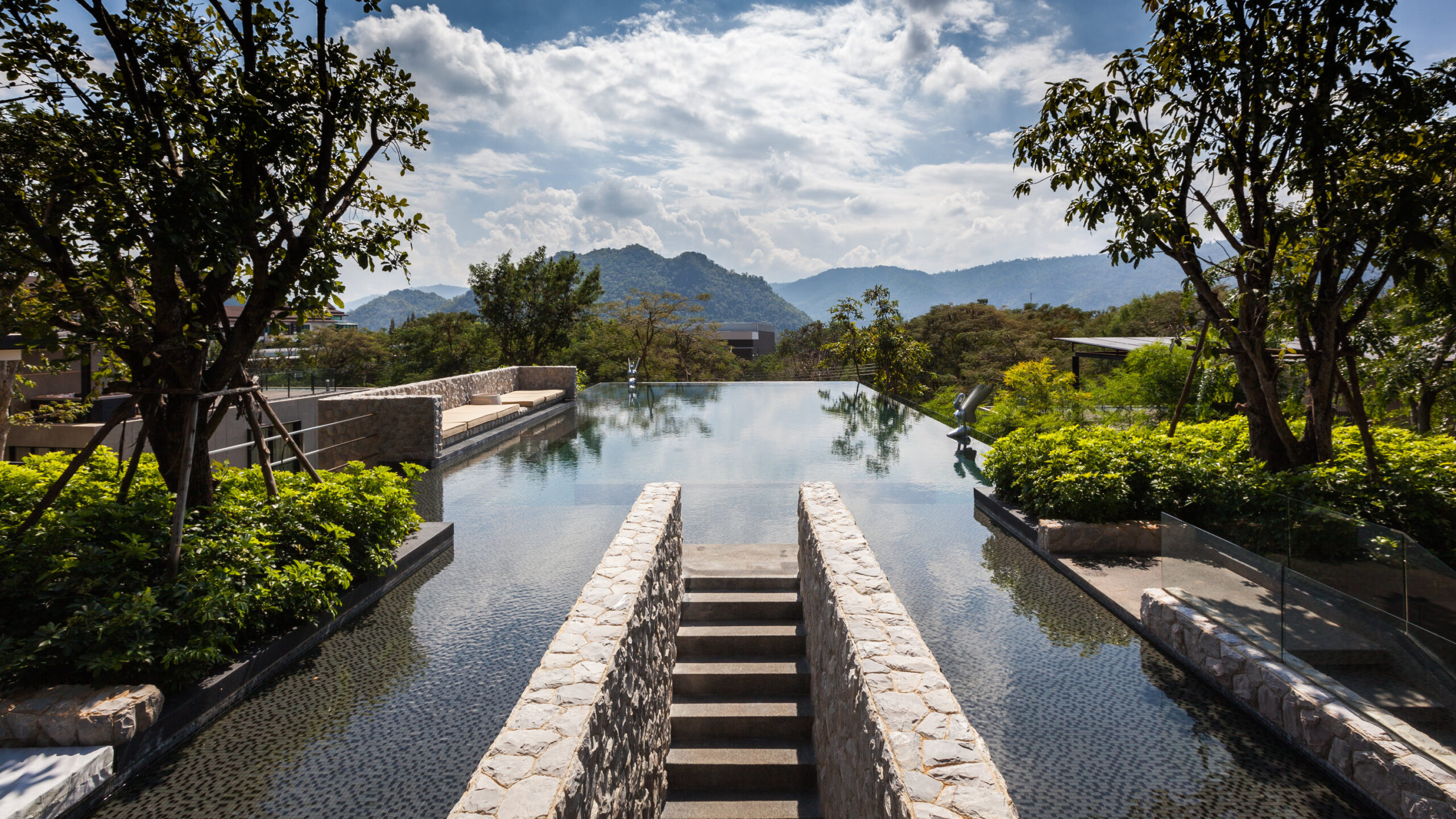
Encouraging good health was one of our main objectives when designing the residential landscape. Two swimming pools are included in the design: The first pool is located on top of a gym and a lounge. Its reflective water camouflages the massive structure underneath, making it totally disappear. The second pool is in the middle of The Park; its water also reflects the mountainous and architectural surroundings, combining all together as part of the overall landscape. A jogging track runs along one side of The Park. Trying to achieve the maximum length of the running track, an elevated jogging bridge is introduced as a tool to multiply the routing options for the runners. The bridge shape also echoes the mountainous skyline of the surrounding area.
Overall, we have developed designs within a contemporary context, but we’ve kept intact the essence of a tropical feeling and atmosphere. This was achieved through the careful consideration of the appropriate layout to ensure the residents can see the beautiful panoramic views of Khao Yai. We believe that contemporary design does not have to be in opposition to nature. The intention for the concept was to create the friendly “forest” to reduce the harshness of a manmade structural form, thus integrating the building and surrounding nature into one.
Project name: Botanica Khao Yai
Location: Nakhon Ratchasima, Thailand
Area: 16,000 m2
Completion: 2015
Photography: Spaceshift Studio
C O L L A B O R A T I O N
Client: The Scenical Development Company Limited
Architect: Vin Varavarn Architects Co., Ltd.
Interior: Define Studio Co., Ltd.; Mada Design Factory Co., Ltd.
T R O P S T E R D E S I G N
Design Director: Pok Kobkongsanti
Team: Peerasit Sangwanloy, Chanchai Wimonsirichotikun