Located in the new district of Qujiang, Xi’an, the Grand Milestone Art Centre was set to be the sales gallery and clubhouse for future development within the same plot. Comprising both public and private connotations, the client and design team sought to successfully promote pedestrian accessibility for both the visitors and local communities. The project boasts a sophisticated and intricate landscape wherein each garden and courtyard takes its place as a living background for the exhibited artwork. But for these wonders to be fully appreciated, visitors needed easy access to the site. We proposed the “Ribbon Dance Park,” where a meandering ribbon-like boardwalk reconnects the existing footbridge and pavement with the new development, reinvigorating and adding value to the neighborhood. The long, green corridor acts as the development’s front yard. Here, the landscape team envisioned a transitional public park that slowly draws visitors into a fully immersive landscape experience. This boardwalk, extending above the new entry driveway and directing people to the nearby Xi’an botanical gardens, lightly touches the steeply sloping ground while meandering to create rooms and viewpoints of various sizes. The result is an ethereal boardwalk that emerges from the various green shades of the surrounding landscape. Finally, the park would not be complete without the uncomplicated yet ingenious selection of native grasses and cedar trees. The plants, rustling and softly bleeding into the pathway through the gaps between each balustrade, create a dynamic landscape that changes its forms and colors all year round.
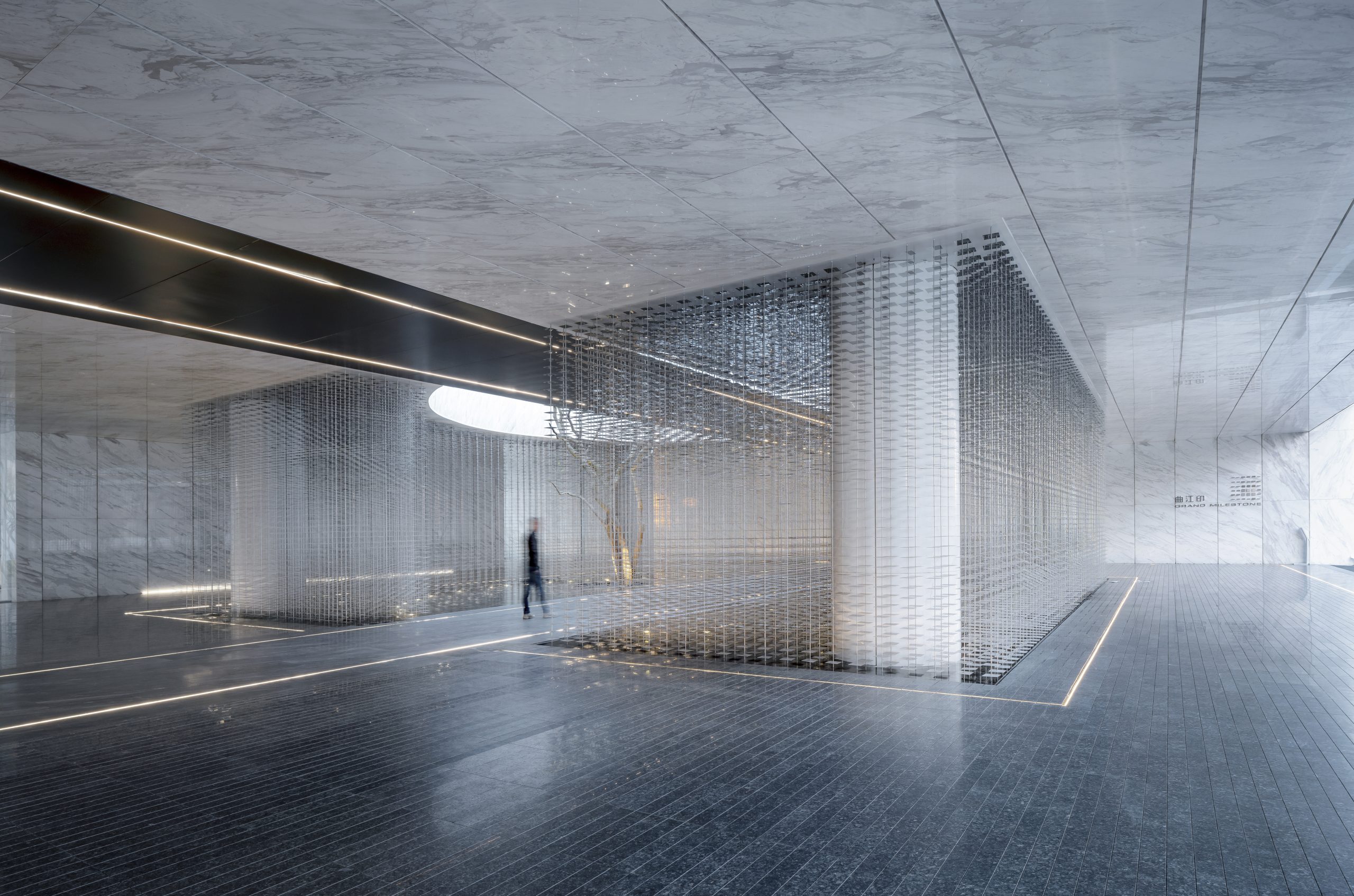
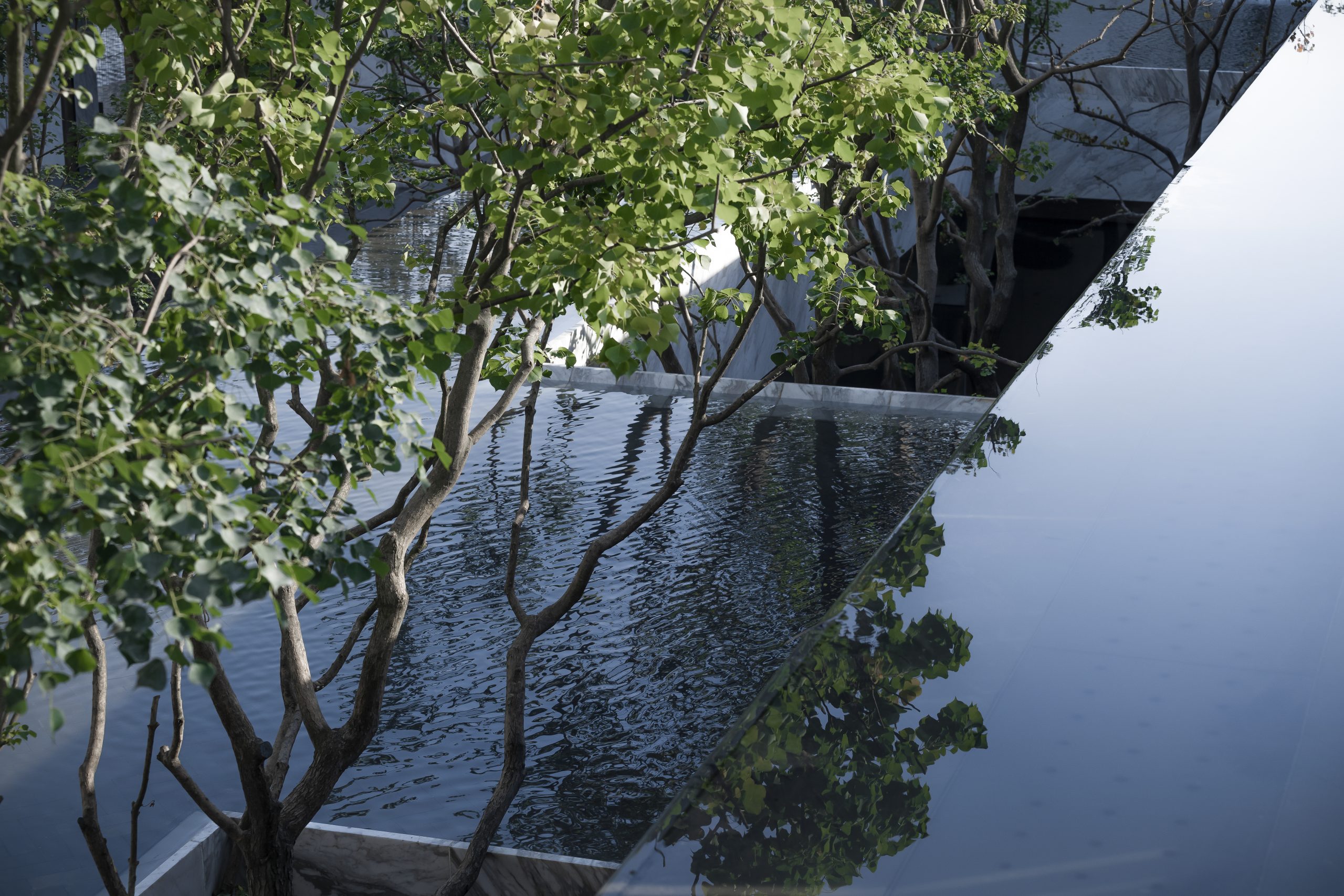
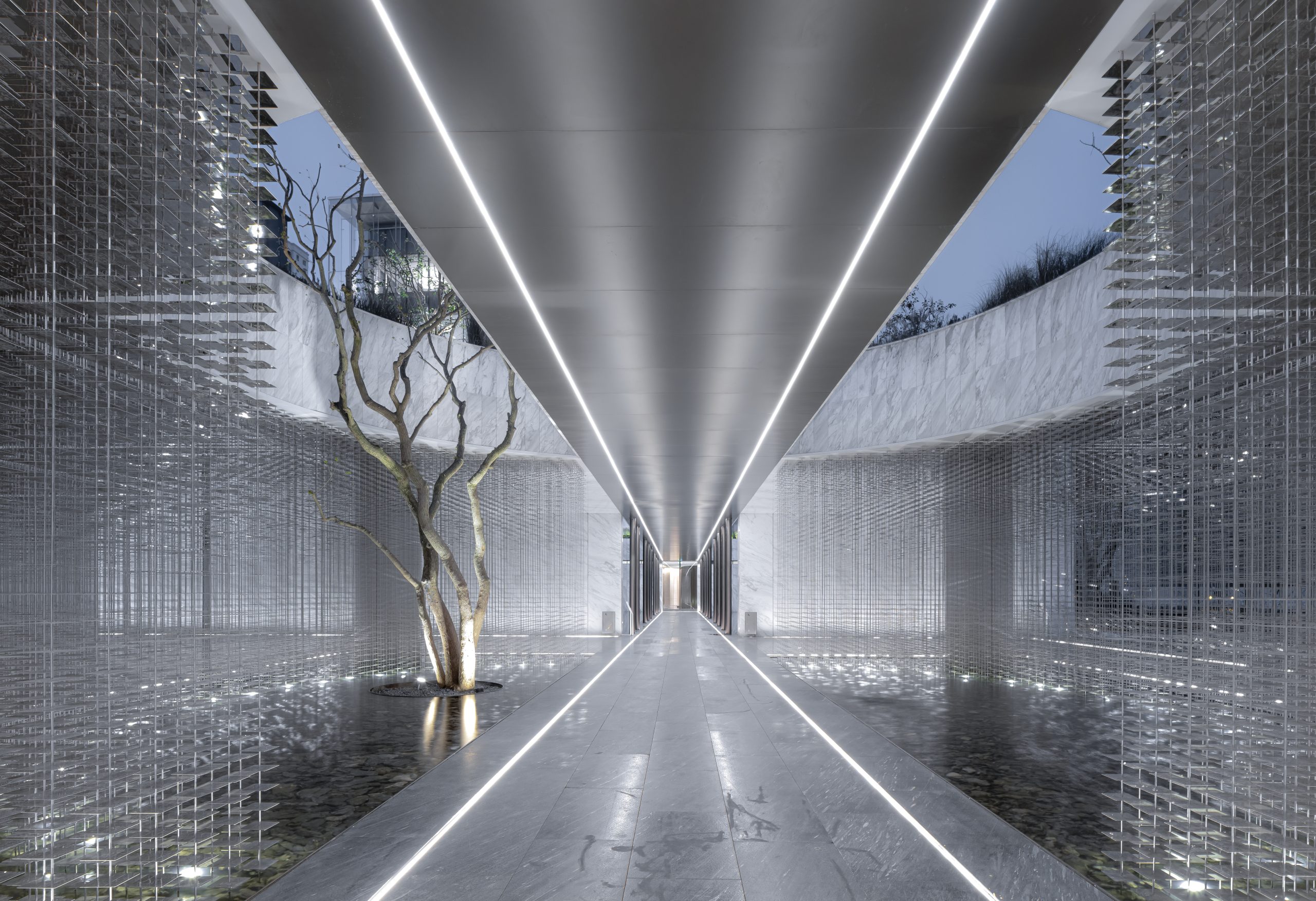
The Gallery Arrival Court is where the gallery welcomes all the visitors travelling by car. To create a powerful sense of arrival, the landscape team reinvented this drop-off point, turning it into an extraordinary “Court of Light.” Instead of leaving the roundabout empty, tens of thousands of small, shiny aluminum plates float together in the form of a conceptual cuboid room that wraps around four exposed columns. A direct visitor’s path from the sheltered parking area was added through the center of the subtracted spheric space within this room, creating a vista into the inner “Water Courtyard.” Within the spheric extent lies a reflecting pool and a “Lonely Dancer” tree. In the daytime, the open roof above allows natural light to fill the space, creating an unending reflection involving the aluminum plates and water that shines onto the tree. At night, the lighting illuminates the spheric volume from below, producing an otherworldly stage that marks the great beginning of the visitors’ journey into the gallery.
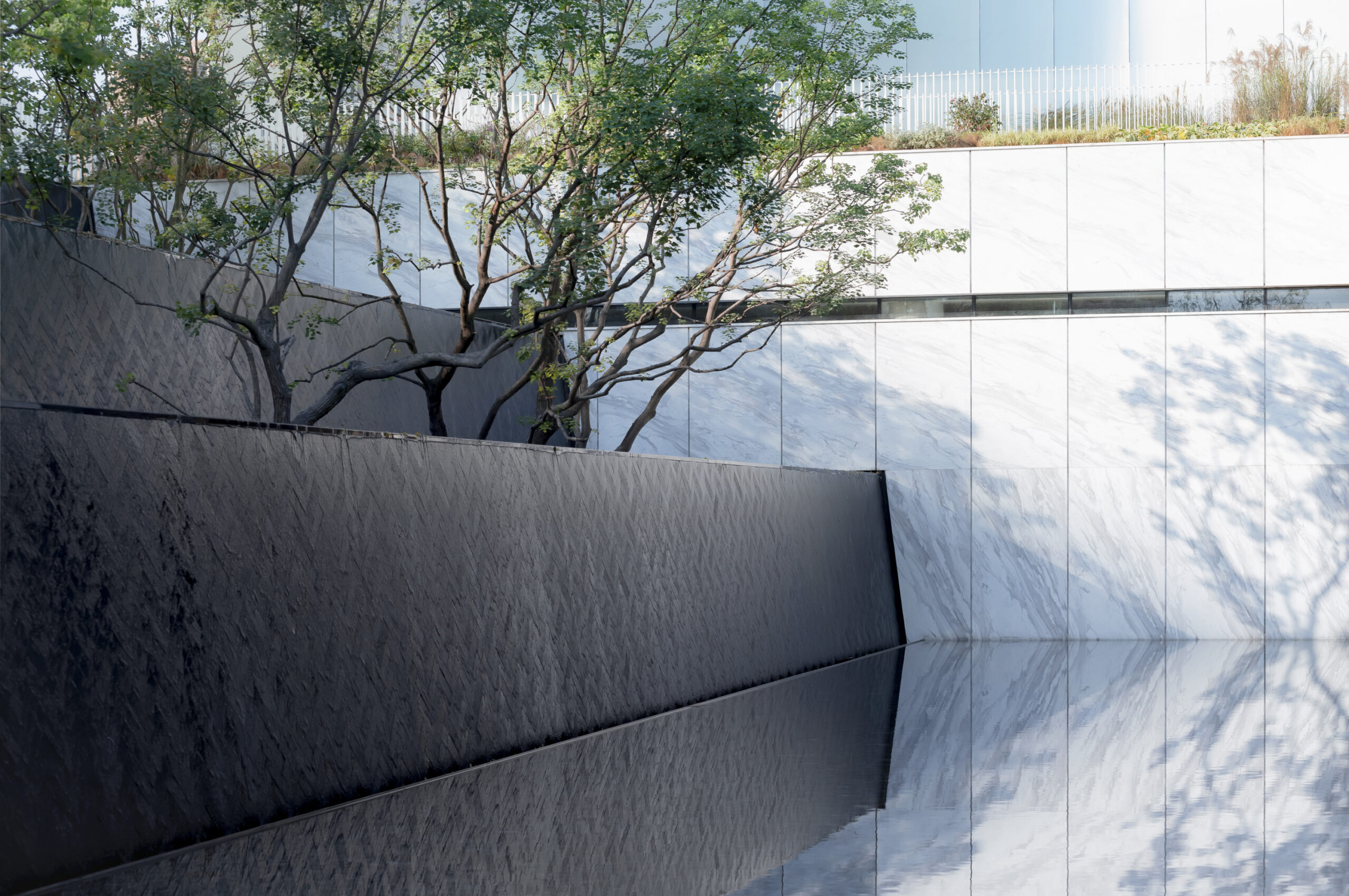
Leaving the Court of Light, visitors find themselves immersed in the sound of the waterfalls. This fully enclosed Water Courtyard displays a symmetrical arrangement of three landscape features: a straight path through the middle of a reflective pool, several groups of trees in various locations, and a series of long, multi-levelled waterfalls on one side. The indoor gallery initially lacked full integration with the landscape as it was clearly separated from the Water Courtyard. To create an infinite continuity between indoors and outdoors, the landscape team proposed a modification to the gallery spaces by subtracting some exhibition area and replacing it with courtyards, permitting more natural light into the gallery. The single waterfall was transformed into a three-tiered cascading pool. Eighteen Sapium trees in total were planted throughout all six court gardens, creating a painting-like backdrop for various indoor exhibitions while complementing and softening the cascading waterfall structure seen from within the Water Courtyard. The result is the seamless connection between the architecture, interior spaces, and landscape that are all specially made for one another. In the center of the rear garden lies another exhibit building, connected to the main gallery with an indoor walkway with floor-to-ceiling glass windows entirely opening up to the surrounding landscape. The garden ground is perceived as one giant canvas for an abstract painting: “The Magical Forest.”
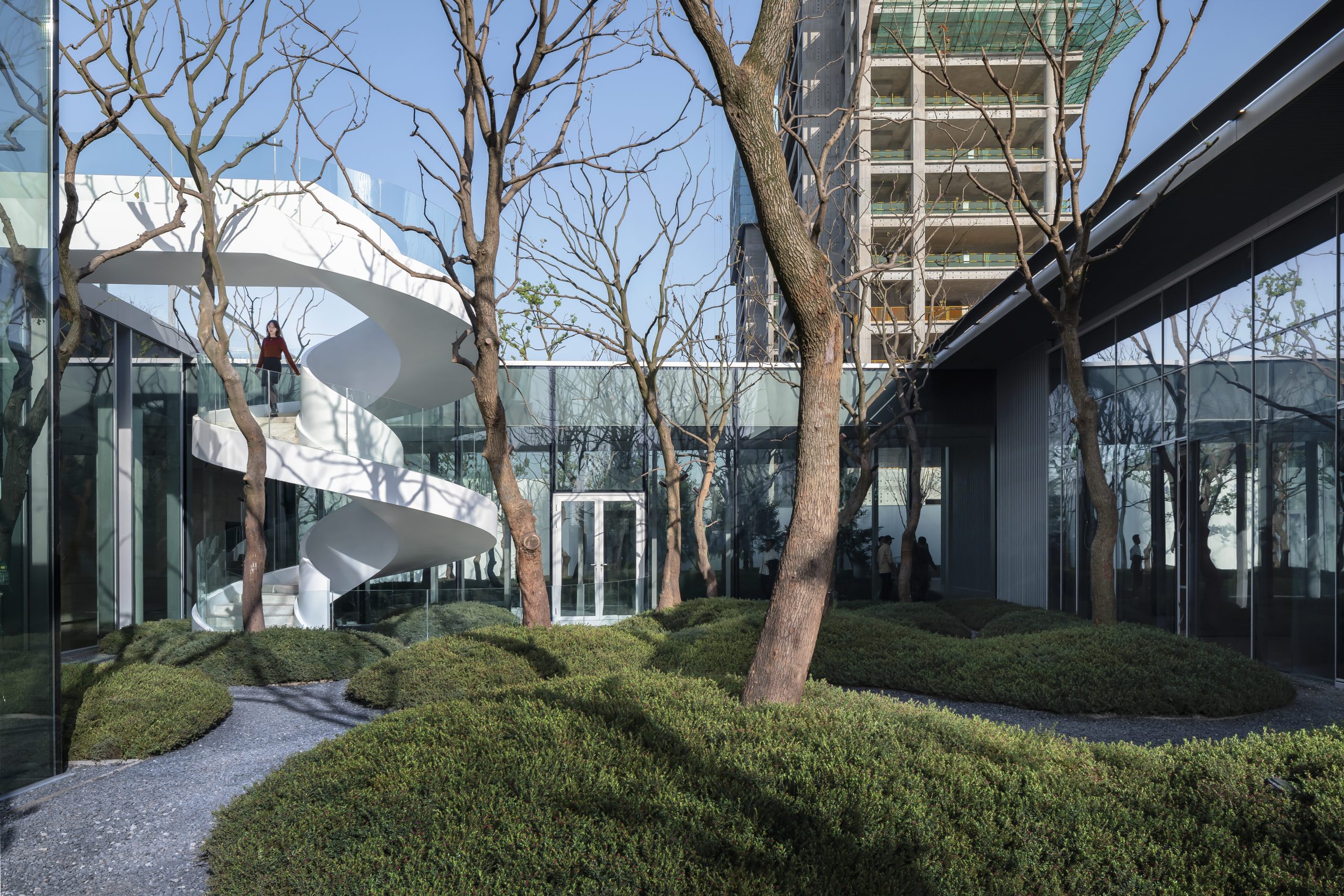
Inspired by interconnected blobs of paint, the soft undulating mounds bleed into the entire space and display a tranquil tone. To maximize water retention in the dry climate of Xi’an, the landscape team filled the paths in between these mounds with gravel, creating an entirely porous garden. Deciduous trees with light foliage and sculptural forms are dispersed randomly within the area, creating a sparse forest but with almost consistent spacing. The forest animates the courtyards and adjacent interior spaces by filtering the sunlight with its ever-changing canopies through the seasons, and it stands firm as a multi-dimensional artwork itself. The landscape team saw the flat roof of the gallery tower as the perfect platform for an artistic garden inspired by the dappling of colors in Monet’s Impressionist paintings. The meticulous planting design plays an essential role in the appearance of this garden. To display intricate contrasts of textures and colors all year-round, a great variety of winter-tolerant ornamental grasses are carefully interspersed throughout the roof extent, with evergreen grasses, perennial shrubs, and trees in selected places as the accents. The simplistic garden path forms a complete loop with smooth, undulating curves resembling the design language of the Ribbon Dance Boardwalk. At different points on the path, three circular seating spaces squeeze themselves into the grassy landscape, creating an outdoor room for the visitors to fully immerse in the field of various colors and textures around them. Today, the Ribbon Dance Park is widely used by the local communities, with people strolling along the meandering paths or using the landscape for jogging, as a playground, or as outdoor living rooms, generating a meaningful project for the district.
Project name: Ribbon Dance Park
Location: Xi’an, China
Area: 38,000 m2
Completion: 2019
Photography: Holi Landscape Photography, Shiromio Studio,Tothree design
C O L L A B O R A T I O N
Client: Sunac Group (Xi An)
Architect: gad
Interior: CCD, SCDA
Local team: Shanghai Weimar Landscape
Environment Visual System: Tothree design
T R O P S T E R D E S I G N
Design Director: Pok Kobkongsanti
Team: Fusang Ren, Huamei Yin, Yunya Tang, Pitchayut Luadsoongnern